


How to Relieve Your Sciatica Pain with Physical Therapy
Are you experiencing the following symptoms?
- Burning or “electric” pain that radiates from your lower back down through your leg
- Numbness, tingling, or a pins and needles sensation in your back or leg
- A sense of weakness or heaviness in your leg
If so, you may have developed sciatica, which isn’t so much a condition in and of itself as it is a sign of something else, such as a herniated disc or issues with your spine. It develops when the sciatic nerve–a major nerve that runs from your lower back all the way down to your feet–becomes pinched or irritated in some way.
Sciatica is a somewhat misunderstood term. Some people use it to describe any pain or discomfort in the lower half of your body. But true sciatica is a neuropathy that affects the sciatic nerve, and to address it, you need to resolve the underlying source of irritation to the sciatic nerve.
Fortunately, the physical therapists at Darien Physical Therapy can help you do exactly that! Today, we want to give you a glimpse of the process we use when addressing sciatica and sciatic pain.
Exercise of the Month
Double Knee To Chest
Start on your back with your knees bent. Slowly bring both knees to your chest. Grasp your knees. Hold for 30 seconds and repeat.



Step 1: Confirm Sciatica and Uncover the Cause
When you visit us for your first appointment, we’ll begin by confirming that the discomfort in your lower extremity actually involves the sciatic nerve at all. Other conditions can cause sciatica-like symptoms, such as spinal osteoarthritis or piriformis syndrome.
If we confirm that your sciatic nerve is impaired, our next step is figuring out why. By far, the most common cause of sciatica is a herniated disc, which occurs when an intervertebral disc bulges and presses against the sciatic nerve. Less commonly, spinal stenosis (a narrowing of the spinal canal) can irritate the sciatica nerve, as can damage from osteoarthritis.
Step 2: Develop a Treatment Plan
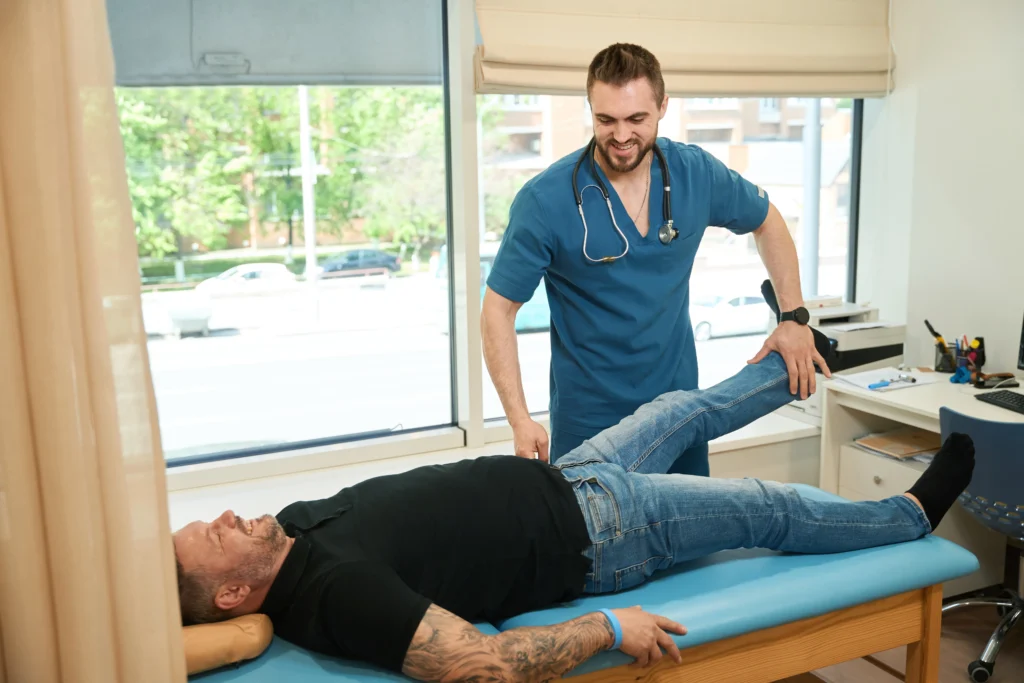
Once we know why you’ve developed sciatica, we’ll work to develop a treatment plan to address that underlying cause. Fortunately, physical therapy is the preferred method for treating most of the common causes of sciatic pain.
If your sciatica results from a herniated disc, we’ll help you reduce your pain and facilitate your recovery. Herniated discs will generally resolve within 2-8 weeks, and regular physical therapy can help speed up that process. You can expect the following:
- A drug-free pain management plan utilizing manual therapy, movement modifications, and pain-relieving modalities
- Targeted mobility exercises to free up restrictions in your spine
- Postural corrections to remove pressure from the herniated disc
- Strengthening exercises, particularly in your core, to help stabilize and support the spine
- A return-to-activity schedule to ensure you don’t reinjure yourself
If your sciatica results from spinal stenosis or arthritis, we’ll focus on helping to relieve the pressure from your sciatic nerve. Treatment will generally resemble what we do for herniated discs, including pain management, mobility work, and strengthening exercises, adapting them as needed.
Step 3: Prevent Future Bouts of Sciatica
Once we’ve helped resolve your sciatica, we also want to help prevent it from occurring again. We’ll provide you with the guidance you need to stay pain-free. Here are a few sciatica prevention tips to get you started:
- Improve your posture, which means keeping your spine in alignment. Our PTs can show you how!
- Avoid prolonged postures, especially prolonged sitting. If you have a desk job, get up and move around every 30 minutes or so. If you have a job that requires you to stand in one position for an extended period, take breaks and switch up how you’re standing (such as shifting your weight back and forth).
- Get moving! A regular exercise routine will help keep your back and core muscles strong. Our physical therapists can suggest specific exercises and workout options to ensure you stay active even after finishing physical therapy.
- Use proper lifting techniques. We’ll show you what you need to know.
Sources: https://www.choosept.com/guide/physical-therapy-guide-herniated-disk, https://www.physio-pedia.com/Sciatica
Say Goodbye to Sciatica Pain
If you suspect you’re dealing with sciatica, call the team at Darien Physical Therapy to make an appointment. We can let you know for certain and guide you to lasting pain relief–whether or not your sciatic nerve is to blame.

Solving Health Mysteries: Meet Christine!
Have you ever left a doctor’s office with more questions than answers? Have you wondered what your diagnosis really meant? Or perhaps you left with an unsolved mystery as to why you were experiencing symptoms? Perhaps you were given a prescription and sent on your way.
But did you ever wonder how you got to this diagnosis in the first place? What happened? And did you wonder if there was anything you might be able to do to restore your normal function, in addition to just taking medication to fix the symptoms?
Perhaps you have been to multiple doctors and are still looking for answers. Even the very best physicians are strapped for time these days, and you may still have questions.
Christine is a “health detective”. She is trained as a functional nutritionist, but she does more than help you plan dietary strategies. Christine can help you explore and learn about your own unique body and can often help you solve health mysteries and get you back on a restorative path.
Whether you have serious chronic health issues, or you just want an overview of a health topic for you or your family, Christine is here to be your guide, your educator, and your advocate. Book an appointment today!
Bellwether Wellness is co-located in the Darien Physical Therapy office but also operates via Telehealth.
You can make an appointment at the front desk in the office or go to www.bellwetherwellness.com to schedule for yourself.

Cherry-Berry Oatmeal Smoothies
- 1/2 cup quick-cooking rolled oats
- ½ cup light almond milk
- ¾ cup fresh strawberries
- ½ cup fresh dark sweet cherries
- 1-2 tbsp almond butter
- 1 tbsp honey
- ½ cup small ice cubes
In a medium bowl, combine water and oats. Microwave for 1 minute. Stir in ¼ cup of the milk. Microwave for 30 to 50 seconds more or until oats are very tender. Cool 5 minutes. In a blender combine oat mixture, the remaining ¼ cup milk, and the next four ingredients (through honey). Cover and blend until smooth, scraping the container as needed. Add ice cubes; cover and blend until smooth. If desired, top each serving with additional fruit.